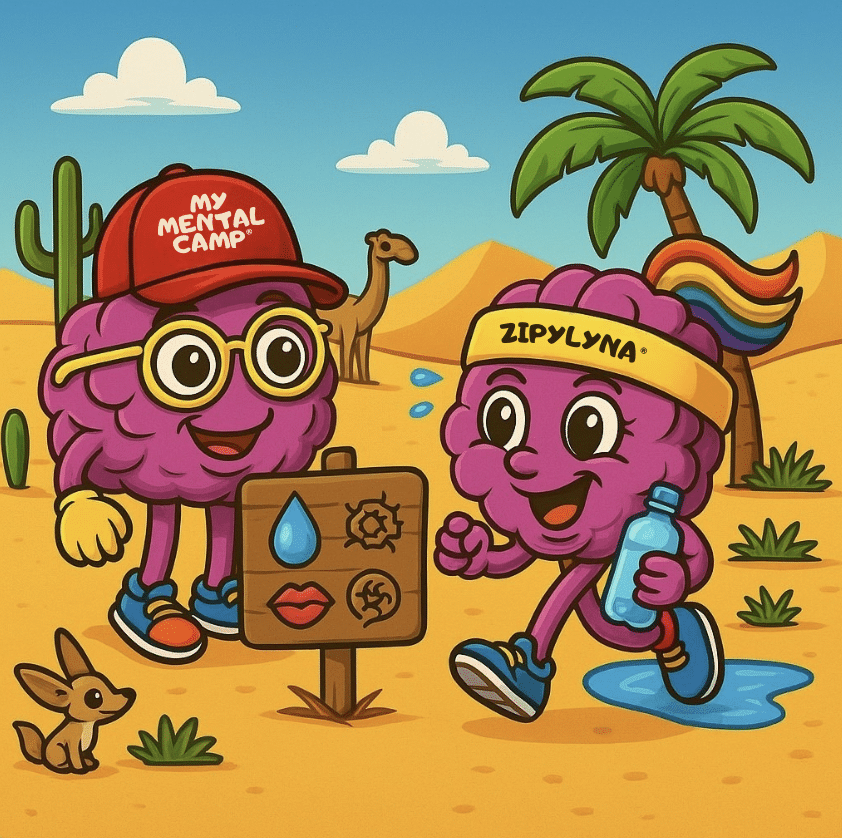
“The sun is burning, the sand is crunching, the chocolate is melting. Welcome to the toughest stage of your endurance life: the great thirst test.” – Zipyly, desert mentor with sun hat

Zipylyna trudges through the endless expanse of a glowing desert landscape. On her head is a yellow headband with a glittering cactus, in her hand an almost empty water bottle. In the other? A cucumber. Of course. “I drank two liters today – I’m basically a pro!” she proudly shouts into the shimmering heat. No one answers. Only a cactus claps wearily at a tapping beetle. Suddenly – WHOOSH! – Zipyly shoots out of the sand on a fan-powered scooter board with Zamyly his mini camel. He wears a turban, yellow glasses and looks like a mixture of sheikh, brain researcher and overheated thermometer. “And how much of that did you sweat out during training?” Zipyly asks curiously. Zipylyna shrugs her shoulders. “Details…” She bites into her cucumber. The camel in the background moans softly. Zipyly pulls a whiteboard out of his turban, unfolds it like a foldable desert tent and calls out: “Time for a little plain-language trip to the oasis of knowledge.”
💧 Desert station 1 – What does hydration actually mean?
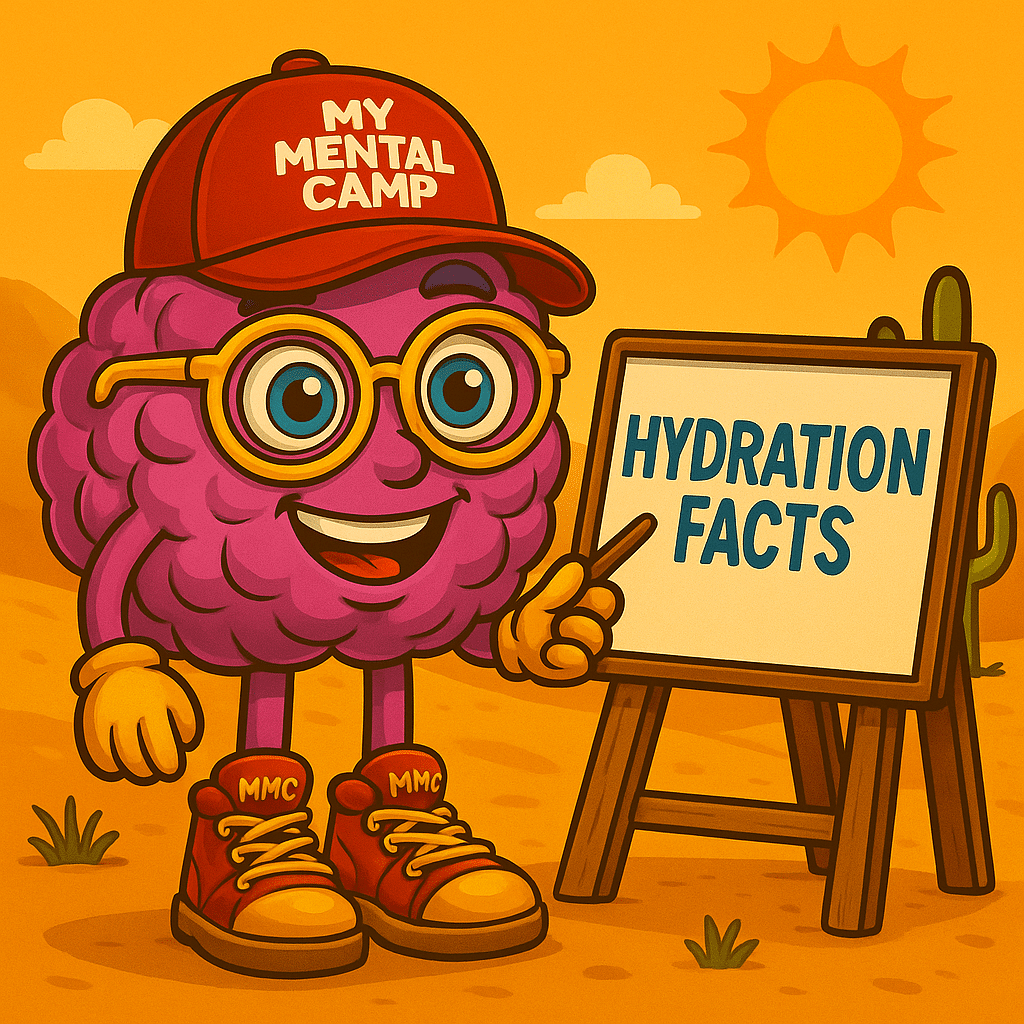
Hydration doesn’t just mean “drinking lots of water”. It means: Your body gets exactly the fluids and electrolytes it needs – at the right time. Because without this combination, your system runs like a smoothie blender without a knife: full of power, but nothing happens!
📊 The two main heroes of hydration
| 💧 Component | 🧠 Function |
|---|---|
| Water | Temperature controller, means of transportation, lubricant |
| Electrolytes | Small ions, huge effect (e.g. sodium, potassium, magnesium) |
“Drinking only water is like running through the desert with an empty GPS. At some point you’ll be lost – and burn out.” – Zipyly
💧 Body composition – you’re more cactus than cookie
Zipyly waves, and a hologram table appears between two date palms:
| 🧍♀️ Body part | 💦 Water content |
|---|---|
| Brain | approx. 75 % |
| Blood | approx. 90 % |
| Musculature | approx. 70 % |
| Entire body | approx. 60-65 % |
“You’re more of an aquatic creature than a land animal. Without water, you’re functionally a dried-up gummy bear,” says Zipyly. Zipylyna grins. “So I’m a walking fruit jelly?” Zipyly counters: “Only if you look after it properly. Otherwise you’ll turn into a dusty raisin in your running shoe.” Zamyly ponders in horror what would be left of him and sees himself withering away in his mind’s eye as a withered cactus flower.
💀 What happens with dehydration?
A fluid loss of just 2% of your body weight is enough to cause your engine to stutter:
- Loss of concentration
- Increased pulse
- Muscle cramps
- Drop in performance
- Mood swings (“I hate everything – except iced tea”)
And that’s before you even feel thirsty!
🧪 Study situation
Sawka et al, 2007 show: A water loss of just a few percent significantly reduces endurance, temperature control and cognitive performance. Zipyly pushes a pair of cactus sunglasses over his face and comments: “Thirst is not a strategy – it’s an emergency program. And in the desert, that’s … bad.”
📌 Remember like a desert fox:
“Hydration doesn’t just mean drinking like a camel – it means drinking like a strategist. With the right mix of water & electrolytes, you’ll last longer, stay clear-headed and won’t have to beg the nearest cactus for an iced tea,” says Zipyly. What happens in your mind & body before you’re even thirsty – and why your performance is already sinking into the sand while you’re still thinking: “Everything’s easy.” See what happens next with Zipylyna and be surprised.
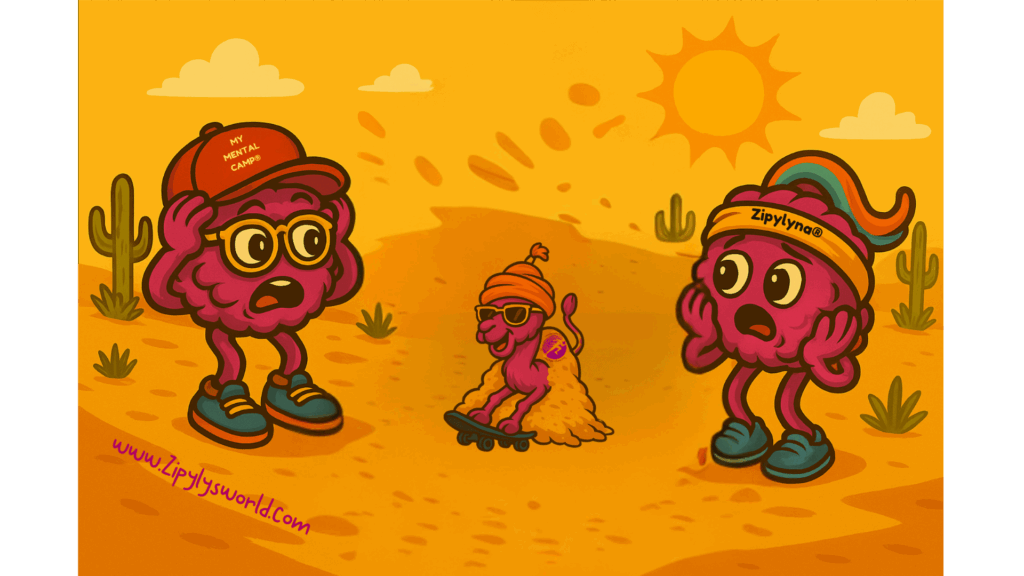
👉 At that moment, Zamyly rolls past, juggling several Mermaid smoothies on his board and mumbles: “Or just drink it when it glitters!” – before he crashes spectacularly into a mound of sand with only his head and turban tassel sticking out.
📉Desert station 2 – Effects on performance & cognition
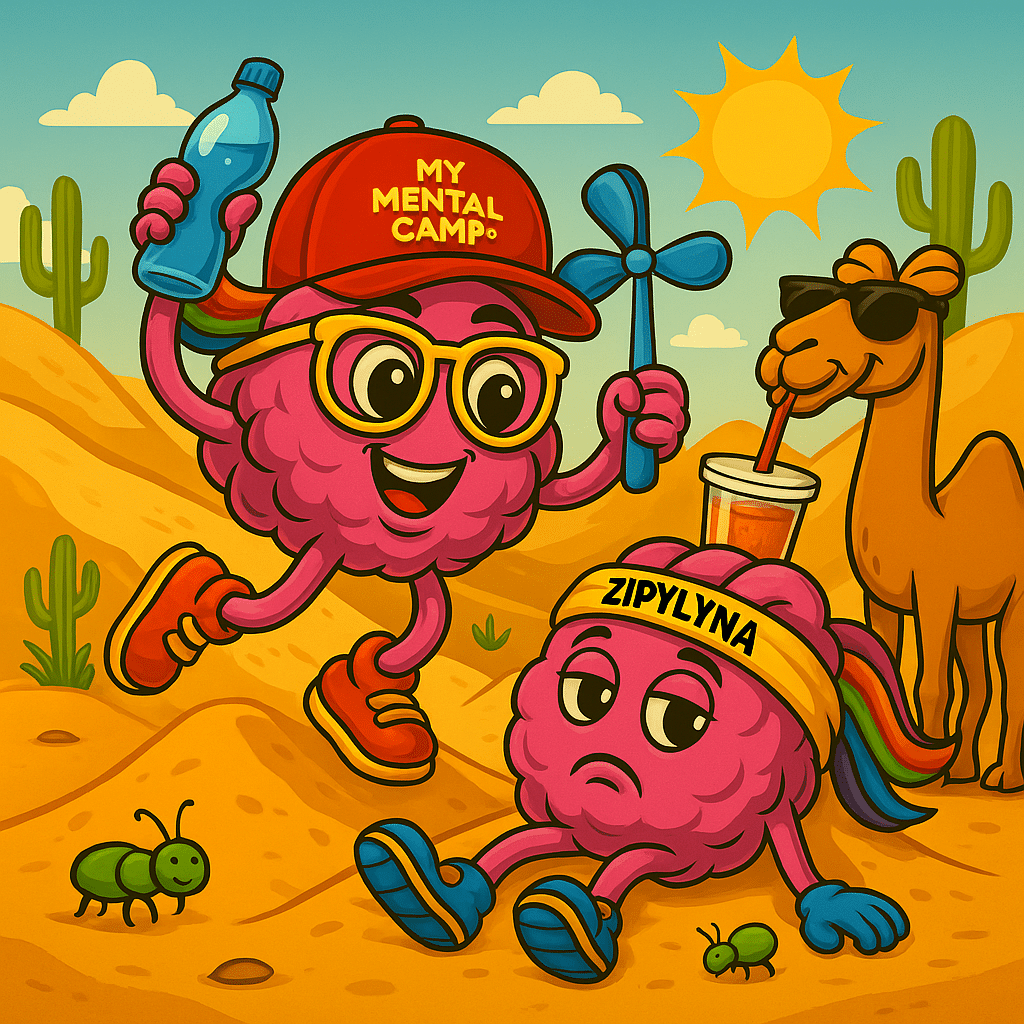
Zipylyna trots through the shimmering heat of an endless dune landscape. The first 12 minutes go like clockwork – the sand crunches rhythmically underfoot, the sun hat fits perfectly, and somewhere in the distance a mirage beckons with iced coffee. Then it happens: she almost stumbles over a small mound of sand, stops, blinks into the bright light … “Wait a minute – didn’t I just pass here?” Her thoughts swirl like a cloud of desert dust in a storm, haphazard and chaotic. Suddenly Zipyly is standing on a camel balancing on a sloping dune. In his hand is a clipboard with “Hydration Audit” written on it, and on his head is a headlamp, as if he is about to dive into a water cave.
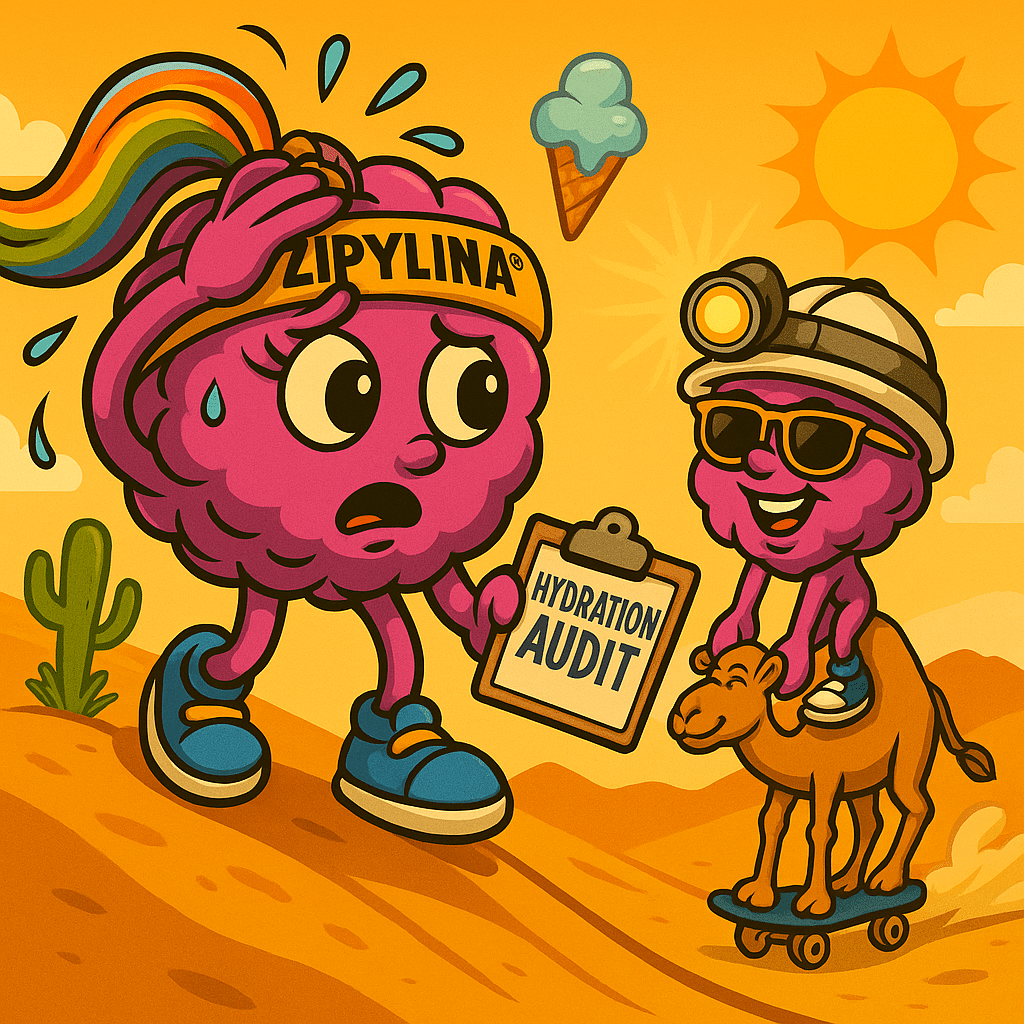
Right off the mark: Zamyly! He digs frantically in the sand with a tiny jackhammer, as if searching for a hidden spring. A fountain of sand shoots up. When Zipyly switches on his headlamp, Zamyly grins broadly – and turns on a floodlight that is far too bright, blinding everyone. In his imagination, he has long since become Indiana Jones on a treasure hunt.
Zipyly shouts: “You left out the drinking, didn’t you?”. Zipylyna grumbles: “Just a little experiment …”
🧠 At what point does the power measurably decrease?
Just 2% fluid loss means
- Higher heart rate with the same load
- Earlier drop in performance
- Lack of concentration
- Slump in sentiment
And all this before you even feel really “thirsty”! In the desert, this can mean: you’re still running – but your head has long since finished.
🧪 Studies on 2% fluid loss = -10% performance
📚 Cheuvront & Kenefick (2014): A fluid loss of 2% of body weight reduces endurance performance by up to 10%. Cognitive abilities such as decision-making and attention also suffer noticeably. Zipyly: “That’s not a perceived 10%, it’s a measurable loss – and that’s before you fall asleep.”
😵 Mental effects (concentration & mood)
📚 Adan (2012) shows that even mild dehydration leads to:
- Irritability
- Tiredness
- Longer response times
- Increased subjective stress
Zipyly: “That’s why you hugged the cactus on the last run. Because you thought it was a fellow runner.”
🧮 Example calculation with body weight
Let’s assume Zipylyna weighs 65 kg.
During a long run in the desert, she loses approx. 1.3 liters of sweat (= 2% body weight).
This can mean
💀 Loss of concentration – you walk past the saving oasis
🥵 Physical exhaustion much earlier than planned
🫤 Irritability (“Why is this mound of sand talking to me?”)
🧱 Legs like cement – even though your training went well
Zipyly nods seriously and scribbles on his clipboard: “And all because you haven’t had enough to drink. No wonder you think the frog on the camel is your coach.”
📌 Remember like a camel in a sandstorm:
“If you don’t drink enough, you first lose focus, then the joy – and in the end the goal.” – Zipyly, hydration expert with a brain
Zamyly, while he continues to produce sand fountains with his jackhammer: “Don’t stress, guys – I’ll just build us a swimming pool!”
Let’s move on to 3: How does your body actually lose fluid in the desert – and why does this have nothing to do with whether you’re sweating like a waterfall or looking like a dry cookie?
🌡️ Desert station 3 – How does the body lose fluid?
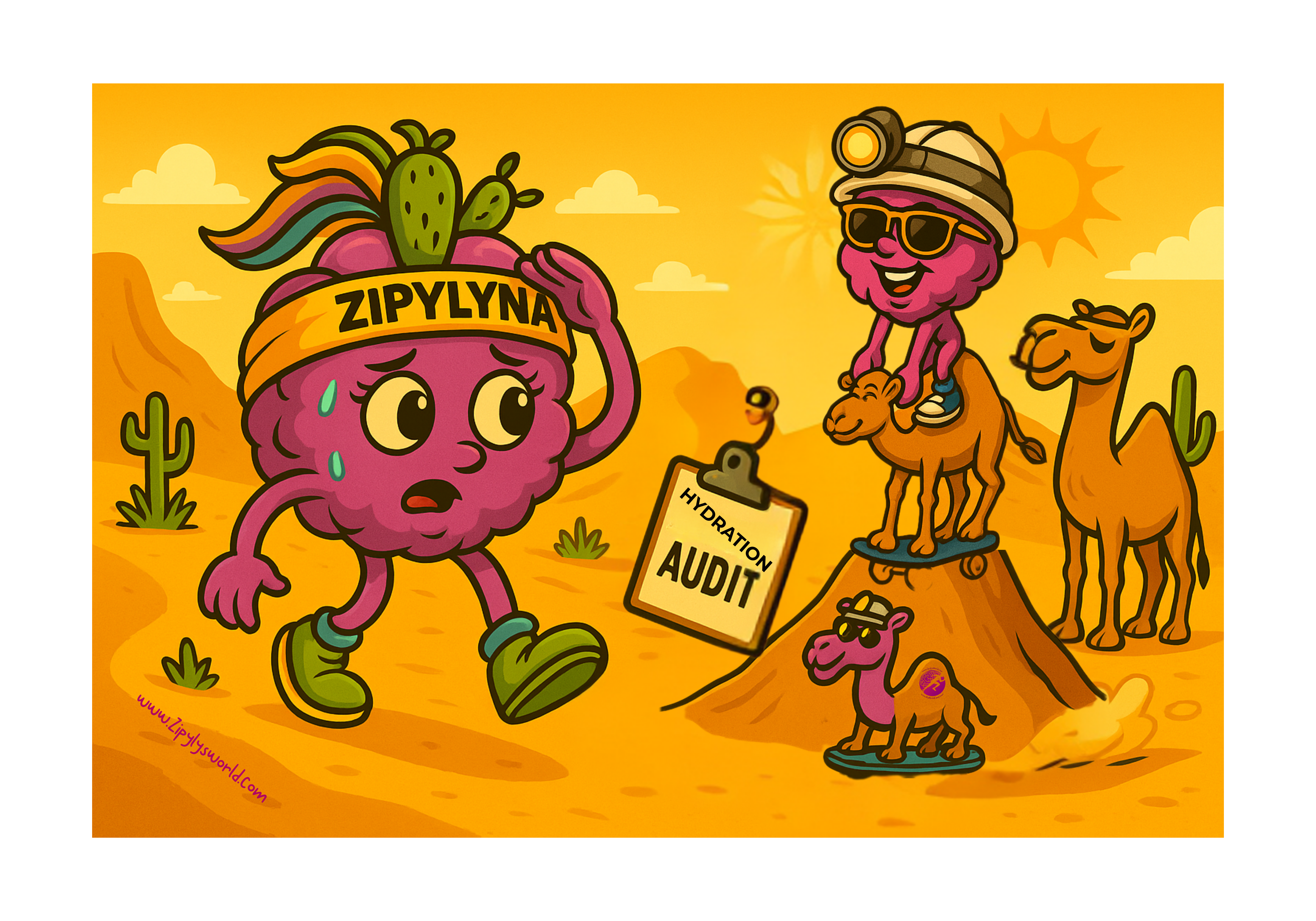
Zipylyna trudges resolutely through the shimmering heat. Today she would do EVERYTHING right: she had already drunk plenty before the start – even two glasses of water more than usual. “I’m basically a portable oasis,” she murmured complacently. But as soon as she started running, she began to … drip. 💦 “I’m sweating like a broken garden hose!” she gasped, fanning herself with her running shirt. Zipyly, who was riding along on a drinking backpack in the shape of a camel – like a mini desert coach – curled up comfortably. “You see – drinking is important. But also to understand where the water goes.” Zipylyna raised an eyebrow, “It’s just going to come off – through my every pore, when I breathe, probably even through my knees.” Zipyly grinned. “Exactly! And now let’s sit over there in the shade of that fake palm tree – I’ll explain it to you scientifically.”
🧬 How does the body lose fluid?
Zipyly scribbles a sketch in the hot sand with a stick, while the wind almost covers it up again:
| 💧 Way | Description |
|---|---|
| 1. sweating | Biggest source of loss in sport – depending on intensity, weather, clothing & fitness level. |
| 2. breathing | Moisture is lost with every exhalation. Zipylyna: “Even when you’re wheezing?” Zipyly: “Yep.” |
| 3. urine & bowel movements | More or less active depending on caffeine or protein consumption. |
| 4. skin evaporation | Even without visible perspiration, the body loses water through the skin. |
| 5. illness, heat, high altitude | Accelerators for water loss – and the desert has at least two of them on offer. |
🔢 Fluid loss during endurance sports
Zipyly pulls a folded table out of his turban like a treasure map:
| Situation | Fluid loss per hour |
|---|---|
| Easy running at 15 °C | 0,8-1,0 l |
| Intensive training at 25 °C | 1,5-2,5 l |
| Competition at 30 °C & sun | 2,5-3,5 l (!) |
Zipylyna stares at the numbers as if he had just revealed to her that camels secretly hide fridges in their humps. “Wait a minute – I can lose almost three liters in 90 minutes? Am I a walking water bomb? ” Zipyly nodded seriously. “That’s exactly why it’s not enough to just drink sometime. You have to stay ahead of the water loss.”
📚 Study note:
The American College of Sports Medicine (ACSM) emphasizes: In endurance sports, sweat loss is usually 1-2.5 liters per hour, depending on body size, climate, intensity and clothing. Without an adequate intake, there is a measurable drop in performance after just 45-60 minutes.
🧠 Note by Zipyly:
“Whoever understands where the water is – also knows why it’s missing.” Zipylyna plucks a palm frond from her head, which has blown into her face as she sits in the “shade”. “Okay, no wonder I feel like dried out toast after a half marathon.”
Suddenly Zamyly jumps out of a mound of sand with a huge inflatable toast under his arm. “I saved it! Your lost water is now breakfast!” Then he takes a hearty bite – and immediately blows a small fountain of water.

💦 Zipyly buries his face in his hands. “… and THAT is exactly why camels never become scientists.” shaking his head, he pulls a mini bucket out of his turbo bag. “And now, my dear Zipylyna, I’ll tell you the biggest misunderstanding of all runners: your body is not a bucket.” Zipylyna blinks. “Um… I drink and it fills up, doesn’t it?” Zipyly leans back, like a camel about to break out a good story. “Nope. Your body has a pretty tight intake control. If you try to flood it with half a lake in a desert minute, it shuts down. Then you’re not hydrated – you’re just a human water slinger.” He points towards the next dune, where a sign is stuck in the sand…
⚠️ Desert station 4 – The body is not a bucket: Limited absorption capacity!
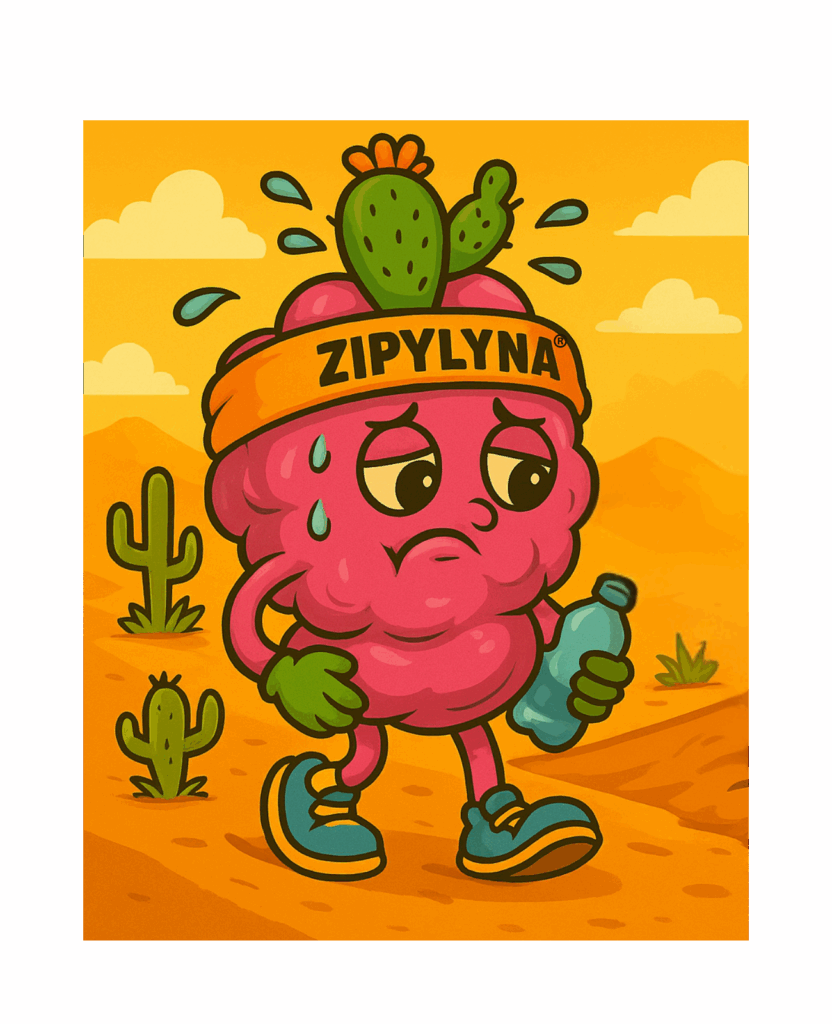
Zipylyna stands in the desert, sweating, panting – and drinking… a lot… a lot! She pours one bottle of water after another in quick succession, while Zipyly watches her with wide open eyes – on his camel, which takes a precautionary step to the side. Gurgle gurgle gurgle… Slurp… Burp. Pause. Then again: gurgle gurgle gurgle… Zipyly pulls a warning sign out of his camel saddle with a sigh: “Stop! You are not a bucket! And this is not a water filling station. Your body has limits – even when drinking.”
🤔 How much fluid can your body actually absorb?
It is a mistake to believe that a lot helps a lot. In fact, there is a natural limit to what your gastrointestinal tract can absorb per hour.
🧪 The facts:
| 🕒 Period | 💧 Absorption capacity (average) |
|---|---|
| per hour | approx. 600-1000 ml liquid |
| with training | up to max. 1.2 l possible |
(depending on how “trained” your stomach is, how hot it is, and whether you are standing still or running) “If you drink more than you can take in, it doesn’t bubble up – it just stops. You become a walking water bottle with gas pressure.” – Zipyly explains emphatically.
🌀 What happens if you drink too much at once?
Zipylyna is now sitting on a stone with a bloated belly. Her headband is flapping askew and she is holding her stomach. “I think I can hear my iso gurgling…” Zipyly nods: ” Welcome to the land of osmosis – a region that no runner wants to voluntarily migrate to. If you don’t pay attention to your electrolyte balance and at the same time pour in more than you can take in, you get…”
Stomach problems
🫠 Inertia instead of energy
🤢 Nausea & bloated stomach
⚖️ Less intake despite more supply
📚 Study note:
Rehrer et al, 1990: The flow of fluid from the stomach to the small intestine is limited, especially during physical activity. Ideal amounts are 150-250 ml every 15-20 minutes, depending on the person.
Zipyly’s desert wisdom:
“A camel can drink 40 liters. Not you. You’re not a camel – and even a camel knows when it’s had enough.” Zipylyna looks at her water bottle, sighs and mumbles: “So I’d rather drink regularly like a little gulping cactus… than once like a waterfall.” Zipyly nods contentedly and summarizes: Conclusion: “It’s not the quantity all at once that makes you fit, but the clever distribution over time and distance. Your body is a flow system, not a rain barrel.” He leans back in the saddle as the camel moves on at a leisurely pace. “And now…” he says with a glance at the horizon, “it’s getting exciting: in the next oasis, the drinking strategies are waiting that will really make you faster – and still get you through the race light on your feet.”
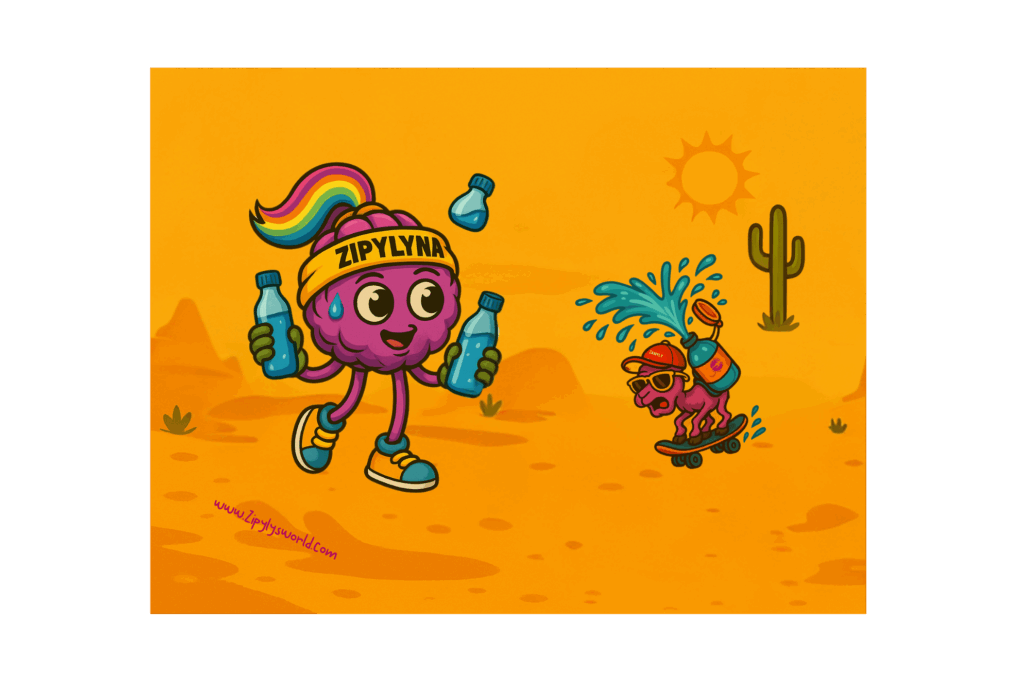
At this moment, Zamyly rides across the picture – on a rickety skateboard with a 40-liter water canister on his back. “Challenge accepted!!!” he shouts – tips the thing over himself and is immediately washed away by a fountain of water as high as a house. 🌊🛹🐪 Zipyly sighs dryly: “That’s exactly why there’s no Olympic discipline of ‘water camel surfing’.”
💧Desert station 5 – How much should you drink – and when?
Anyone can drink – but drinking properly is like well-timed choreography: if you get out of step, you stumble. If you hit the rhythm, you run away like on an oasis. The fine art of learning to drink without mutating into a waterbed.
Zipylyna stands on a small dune. In front of her: five different drinking bottles, two Camelbaks, half a piece of melon and a piled-up coconut with a straw. She looks into the desert, perplexed. “When exactly should I drink something? Before the run? During? After? And how much anyway? I don’t want to roll through the dunes like a ball of goo!”
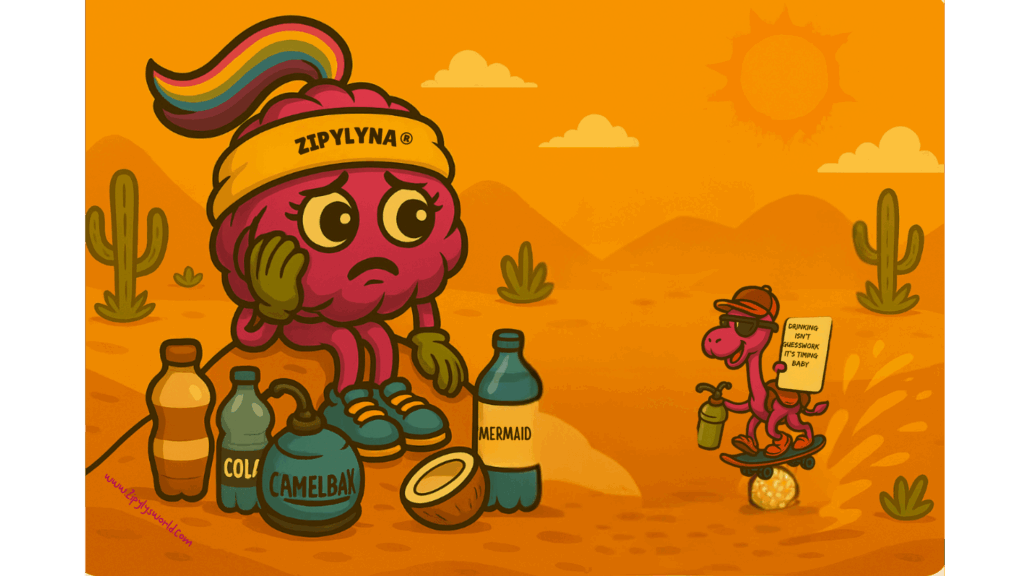
WHOOSH – Zamyly rolls up on a surfboard with sand gliders. He wears goggles with a thermal sensor and holds a mini whiteboard in his hand. “Drinking isn’t a gut feeling – it’s timing, baby.”
⏱️ Before training
Zipyly draws a curve in the sand with a scorpion leg.
Rule of thumb:
🕒 2-4 hours before training: 400-600 ml
🕓 15 minutes beforehand (optional): approx. 150-200 ml
Why?
- So that you don’t start running dehydrated
- But also doesn’t gurgle like a running watering can
“If you drink like a camel just before a race, you’ll burp like one later.” – Zipyly. Zipylyna remembers: “Once before interval training, smoothie + iso drink + coffee… I was burping like a kettle on overheat.”
🏃♀️ During training
Zipyly taps Zipylyna’s headband: “You’re not a stopwatch – but your drinking should have one.”
Guide values per hour of running time:
⚖️ Weight 🌡️ Temp. (approx. 20 °C) 💧 Liquid ⏱️ Recommendation 60 kg – 400-600 ml every 15-20 min 100-150 ml 70 kg – 500-700 ml every 15-20 min 150-180 ml 80 kg – 600-800 ml every 15-20 min 180-200 ml
📌 Note: This can be even more in very hot, dry weather or on mountain runs. But: add slowly, not all at once!
Zipylyna sips a soft flask, almost chokes – then grins: “Okay, I’m officially a hydration pack hamster now. But hey – it works.”
💺 After the training
Zipylyna falls backwards into an oasis. Splash. Turns around. Looks at Zipyly: “Now just drink two liters – and ready for the next time?” Zipyly throws her a towel. “Slowly, desert star. Sweat first, then fill up – with a plan.”
💧 Rule after training:
➜ 1.2-1.5 liters per liter of sweat lost
How do you find out?
→ Simply weigh before and after (naked, sorry 🌵)
→ 1 kg = approx. 1 liter of fluid loss
📌 Example:
Before the run: 65 kg
After the run: 63.8 kg
➜ You have lost approx. 1.2 liters
➜ So drink 1.4-1.8 liters slowly, preferably with electrolytes
🧪 Study check
📖 ACSM (American College of Sports Medicine) recommends:
During exercise: 0.4-0.8 l per hour
Then: adjust to sweat rate, ideally replenish with electrolytes.
Zipyly writes large in the sand: “Your body is not a bucket – it’s a filter.” Zipylyna nods, demonstratively gargles a small amount and says: “So: rather drink like a drip system – instead of like a garden hose at full pressure.”
Heat, cold & altitude: your climate check
Desert day, desert night & dune peaks at 5000 m.
The desert can do both: brutally hot during the day, icy at night. And on top of the dune mountains? Thin air like mint tea.
Zipyly opens a map: “Drinking plan = climate plan.”
☀️ Heat (desert day)
- Welding rate increases (1.5-3.5 l/h are possible in extreme cases).
- Increase sodium requirement: plan ~300-600 mg Na⁺ per hour (individual).
- Drink more towards the upper guideline values (→ 0.7-1.0+ l/h, in small portions).
- Cooling helps: wet your cap, cool your neck, use the shade.
Desert rule: “Drink ahead of thirst, but in sips – not in a torrent.”
❄️ Cold (desert night / winter)
- The feeling of thirst decreases (you “forget” to drink).
- Cold diuresis: You pee more often → more loss, even though you hardly sweat.
- Breathing air is dry → respiratory water loss increases.
- Plan: drink proactively (timer!), slightly warm drinks ok, don’t forget electrolytes.
Desert wisdom: “If you’re not thirsty, look at your fueling – and drink anyway.”
⛰️ Altitude (e.g. from ~2500 m, significantly from 3000-5000 m)
- Hyperventilation → more respiratory water loss.
- Air drier → plan for an additional 0.2-0.4 l/h (individual).
- High altitude diuresis possible → Keep an eye on fluid & sodium.
- Prefer carbohydrates (stomach friendliness, oxygen economy).
- Rule: Small, frequent sips + electrolytes → Balance instead of belly wave.
| Climate | Drink/h (guideline value) | Na⁺-Plan | Pro tip |
|---|---|---|---|
| Heat | 0.7-1.0 l (possibly more) | 300-600 mg | Cool, shade, start early |
| Cold | 0,4-0,7 l | 200-400 mg | Timer, drink warm, thirst is deceptive |
| Height | 0,6-0,9 l (+0,2-0,4) | 300-600 mg | small sips, carbs first |
Zipylyna pulls a down vest over her glitter headband. Zipyly: “Day = melt-proof, night = figure skating. And upstairs, the air is so dry that even the cactus wears scarves.” “Got it,” she says, “I don’t drink by feel, I drink by climate plan.”
Desert wisdom for station 5:
💧 Too little & too late: Your engine is running hot long before you see the finish line.
💧 Too much & too fast: your belly dances samba while your legs stand still.
💧 Just right & in rhythm: you stay light, fast – and even keep a sense of humor.
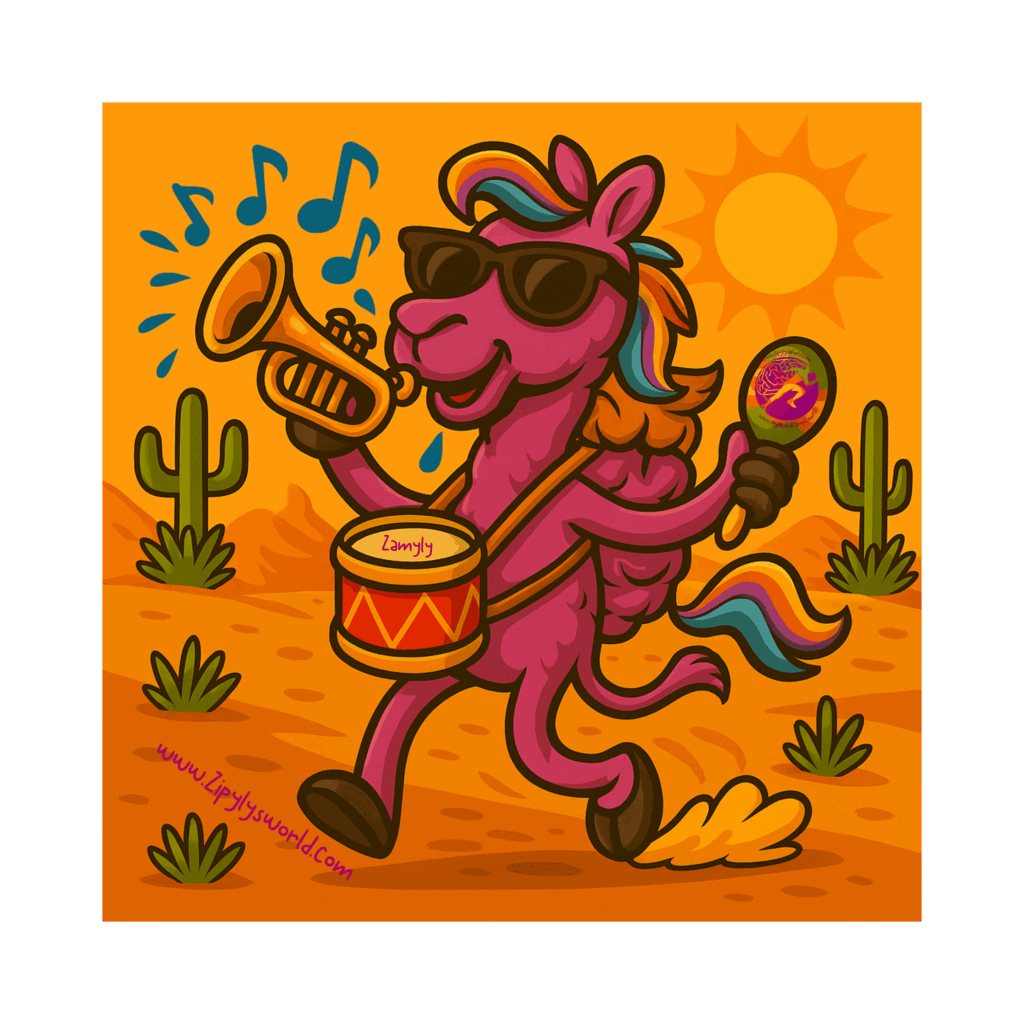
At this moment, Zamyly runs across the picture – colorful with drinking bottles stowed in his humps. He is shouting: “Hydration rhythm? Easy – I just made a drum kit out of it!” 🥁🐪💦 He hammers away, the tempo picks up – and suddenly a bottle comes loose, flies through the air and lands perfectly in Zipylyna’s hand. She sips, nods contentedly and says dryly: “Okay, it doesn’t get any crazier than this – but he’s got timing.” Zipyly mumbles: “That’s the camel’s first meaningful contribution …”
Zipylyna prods Zipyly: “Okay, liquid ninja – but what about the electrolytes now? Is water enough, or am I missing something?” Zipyly jumps onto his sand surfboard and pulls his cap askew: “Spoiler: Without electrolytes, you’re an osmosis experiment in progress. Now wait – with salt, cramps & cactus water.”
⚖️ Desert station 6 – Electrolytes: Why water alone is not enough
Learning from the camel means learning to salt.
Zipylyna trudges over the top of a dune and grins: “I did everything right this time!” She proudly waves a half-filled water bottle, the sand crunches under her running shoes. But shortly before kilometer 17, it happens:
ZACK – a stinging cramp in my thigh, so nasty that even the tapping beetle falls backwards from the cactus, startled. “Ooooo! What the…?! I’ve been drinking!” WHOOSH – Zipyly emerges from a hollow in the sand, holding a camel that looks puzzled. He looks as if he has just interrupted a desert expedition. “Yes, you have. But without electrolytes, water is just… water. And you’re not a watering can.”
🧂 What are electrolytes?
Zipyly rolls his whiteboard out of his camel belly (don’t ask) and writes: Electrolytes = electrically charged minerals that are essential for fluid balance, nerve conduction and muscle work.
🏆 The desert top 4:
| 🧂 Electrolyte | 🛠️ Function | 📌 Important in sport |
|---|---|---|
| Sodium (Na⁺) | Regulates fluid balance, nerve conduction, muscle work | Prevents hyponatremia, keeps water in the body |
| Potassium (K⁺) | Muscle contraction, heart function | Supports regeneration |
| Magnesium (Mg²⁺) | Cramp prophylaxis, energy metabolism | Especially at high welding rates |
| Calcium (Ca²⁺) | Muscle control, bone strength |
🧠 Why is water alone not enough?
Zipyly paints a cactus that is standing in the rain but has no thorns. “If you only drink water, without electrolytes, you dilute your blood. Osmosis ensures that the water simply runs out again – and you lose even more salts.” Zipylyna frowns: “So… like a camel that spills its water again?” “Almost. Except camels are cleverer.” – Zipyly
💣 Without electrolytes can happen:
- Slump in performance (you become a mirage of yourself)
- Muscle cramps (like just now)
- Dizziness
- Headache
- Irritability (“I hate everything… and you… and this cactus!”)
🧪 Study fact:
Casa et al, 2000: Runners who only drank water after exercise regenerated more slowly, lost more sodium – and had cramps more often than those who drank electrolyte drinks.
🍹 And what helps now?
Zipylyna’s notebook flutters in the wind. Zipyly scribbles:
| 🥤 Drink | ✅ Advantage | ⚠️ Attention |
|---|---|---|
| Iso-Drink with sodium | Good choice for long, sweaty sessions | Check composition |
| Coconut water | Natural, rich in potassium | Too little sodium |
| Cucumber water | Contains sodium & vinegar, surprisingly good | A matter of taste |
| Salt tablets | Practical in the heat, Ultras | Observe dosage |
| Self-mix | Water + salt + apple juice + lemon | Keep an eye on the mixing ratio |
“Don’t salt blindly – otherwise there’ll be a big gastrointestinal concert live in the desert.” – Zipyly
🐫 Desert wisdom: “A camel not only stores water, but also minerals. Do as the camel does – but without the hump.” – Zipyly
Zipylyna nods, takes a sip of her newly mixed cucumber water soda and says: “Okay, got it: Drinking + salt = survival. But… can you drink too much?” Zipyly raises his eyebrows, leans on his sand surfboard and lets his gaze wander over the glistening heat: “Oh yes. And that’s one of the most dangerous traps in the desert – it sneaks up on you while you think you’re doing yourself good. Sometimes it’s not too little, but too much that takes you out of the race.” He points to a shimmering dot on the horizon.

💥 A nd Zamyly...: Suddenly the little slob rolls past on inline skates – juggling a load of salt shakers, spilling half of them in the sand and shouting: “Supplies for the desert heroes! Who wants magnesium with glitter?” Zipyly rolls her eyes, Zipylyna laughs tears despite the cramp: “Okay, got it: Drink + salt = survival.”
⚠️ Desert station 7 – Hyponatremia: The underestimated danger
When too much water knocks you out.
The sun is high, Zipylyna trots leisurely through the desert. She stops at every cactus that looks like an improvised refreshment station: sip here, sip there. Half a liter at the oasis in between, then a quick reserve from the hydration bladder. “You don’t want to repeat mistakes,” she murmurs contentedly. But at the finish line – an improvised desert marker made of three palm trees and a tired dromedary – it happens: her stomach hurts, her legs are wobbly, her head is as empty as a wrung-out water bottle. “Zipyly… I think I’m… overdrunk?”
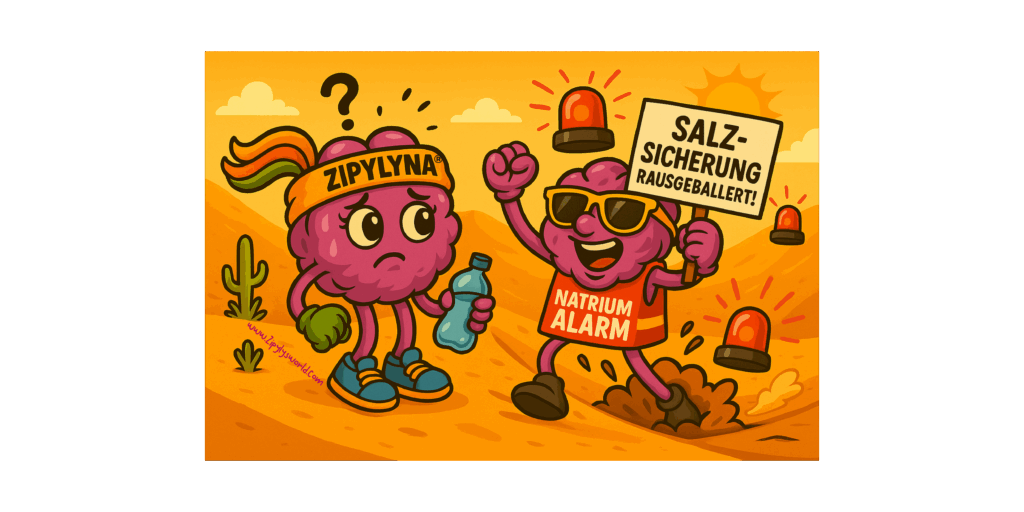
PLOPP! – Zipyly appears from a hole in the sand as if he had pressed the emergency button there. This time he’s wearing a bright red safety vest that reads:“NATRIUM ALARM” “Welcome to hyponatremia, Zipylyna. You’ve just blown your own salt fuse.”
🧂 What is hyponatremia?
Hyponatremia = too little sodium in the blood.
❌ Not a lack of water – but the opposite: too much water, too little salt. The blood becomes diluted, the electrolyte level drops and the body goes crazy. In the desert – and in competition – this can be really dangerous.
🚨 Typical symptoms:
- Headache
- Nausea
- Bloated belly
- Muscle twitching
- Coordination problems
- Confusion
- In extreme cases: unconsciousness or even death
Zipylyna frowns: “Sounds like dehydration…” Zipyly nods seriously.“That’s exactly why it’s so treacherous. From the outside, the signs often look the same – only a blood test can tell for sure.”
🏃♀️ When does this often occur?
- Long endurance races (> 4 hours)
- Cold weather (less thirsty → still drink a lot)
- Excessive drinking of water without electrolytes
- Slow pace (less sweat → less sodium loss → hardly any “warning signs”)
📌 Particularly at risk:
“Slow runners” who drink constantly for fear of dehydration.
🧪 Study alert:
📖 Hew-Butler et al, 2007: 13% of Ironman finishers suffered from hyponatremia – especially those who consumed a lot of water, few electrolytes and were on the road for a long time.
📖 Boston Marathon 2002: A runner died of hyponatremia after panicking and drinking too much water in the last few kilometers.
🧠 Zipyly’s anti-hyponatremia rule:
- Don’t stock up on drinks (“I might get thirsty at some point…”)
- Only drink when plan, thirst or heat demand it
- Plan in electrolytes – especially for competitions > 2h
- Pee check: If the urine is watery & you constantly have to → stop!
Zipylyna sighs: “So not too much and not too little – but like this… “mid-drink”?” Zipyly grins: “Exactly. Welcome to the club of balance obsessives.”
🦂 Wisdom of the desert scorpion:
💧 Too little = heat trap.
💧 Too much = salt trap.
🗝️ Solution: Balance + electrolytes = Happy Runner.
“Too little water makes you a raisin – too much water makes you a water bomb – only the right mixture makes you an oasis.”
While Zipyly is talking, you can see Zamyly hanging on the edge of the dune with an oversized straw in an inflatable mini pool. He pulls and pulls – until a huge fountain spurts out of his nose. “Oooops… I think I’ve just drunk the Atlantic!” 🌊😂 Zipylyna sighs: “Perfect example of hyponatremia… “Zipyly nods dryly: “Exactly that.”

Zipyly toasts her with an iso cup: “To the golden mean – and against the swimming pool in your stomach.” Zipylyna sips and suddenly pulls a thermos flask, a can of Coke and a neon green mermaid shake with a glitter lid out of her backpack. “And… what about coffee? Or cola? Or this Mermaid potion?” Zipyly pushes up her sunglasses and grins: “Chapter 8, baby – now it’s going to be caffeinated, sugary and a bit crazy.”
🧃Desert station 8 – coffee, cola & mermaid shakes
Indulgence or liquid trap?
The sun is blazing, a flicker of heat lies over the dunes. Zipylyna has found a shady spot under the biggest cactus she can find. In front of her: a latte macchiato with oat milk, a half-full Coke and a neon green Mermaid protein shake with a glitter lid. “Tell me, Zipyly… how much of this can I actually drink without my brain imploding or my kidneys dancing the samba?” 🥴
PFFFT! – Zipyly glides out of a camel caravan on roller skates, carrying latte macchiato beans instead of water. He wears sunglasses and waves an espresso cup. “It depends whether you’re running, resting or just pretending you’re in Hawaii.”
☕ Coffee – does it really dehydrate?
Zipyly draws “MYTHOS” large in the sand with coffee powder.
📚 Study note:
(Killer et al., 2014): Moderate coffee consumption (3-4 cups/day) in habitual drinkers has no negative effect on fluid balance. 👉 Means:
- If you drink coffee regularly, you will not lose more water than you take in.
- But: too much caffeine can irritate the stomach/intestines or increase the heart rate – not always ideal in a race.

Zipylyna nods. “So coffee in the morning – yes. Espresso before a marathon – only if I’ve tested it beforehand?” Zipyly: “Exactly. No new caffeine experiments on race day.”
🥤 Coke in competition – old school or game changer?
Zipyly pulls a small bottle of cola out of his turban, unscrews it and pours a tiny sip into a shimmering desert goblet.
Cola contains:
- Sugar (fast energy)
- Caffeine (mental kick)
- some sodium (mini electrolyte boost)
- and the secret magic: “Comfort Fuel ” – simply tastes like “staying power”. 😇
📌 But:
- Only in small quantities (50-100 ml)
- Not too early in the race
- Otherwise there is a risk of a sugar crash or stomach protest
Zipylyna smirks: “Coke as a stopgap sounds kind of… like me.”
🦄 Mermaid shakes & co. – the glittering seducers
Zipyly sighs and nudges Zipylyna’s shake with her foot. “If it glitters, flickers or promises ‘Zen Boost’ – read the fine print.”
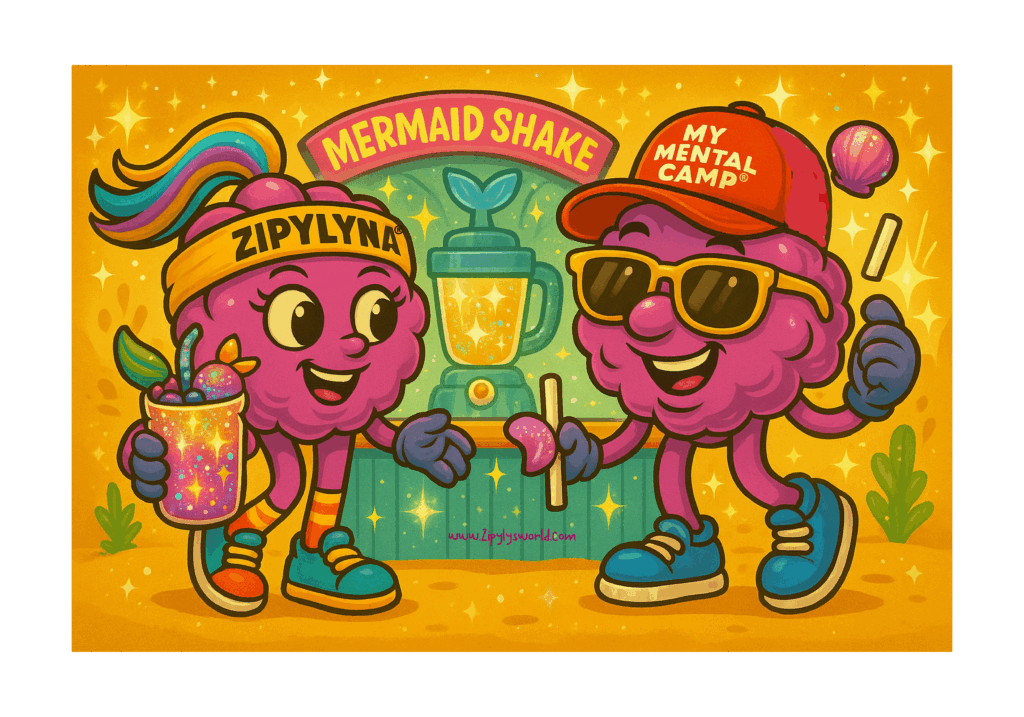
❓ What’s often inside:
- Sugar bombs
- Caffeine shocks
- Artificial colorants
- Too little or too much sodium
📚 Experience from the desert: Many of these drinks tend to work through the placebo effect – they make you feel like you’re drinking something “magical”, even if the actual benefits are limited.
📋 Zipyly’s desert drinks check:
| ✅ Positive | ⚠️ Caution |
|---|---|
| Water – available everywhere | No electrolytes |
| Iso-Drinks – Energy & Salt | Check composition |
| Coffee – a mental kick | Not everyone can tolerate it during sport |
| Cola – sugar & caffeine | Only as a late booster |
| Mermaid shake – motivational kick | Check content, don’t just count glitter |
🪲🌟 Remember the firefly’s mnemonic:
Not every drink is the same. Not everything that screams “energy” really helps your body. And sometimes the best drink is simply water with a pinch of salt. Zipyly toasts Zipylyna with a coconut electrolyte drink: “If your stomach is whispering, ‘What’s THAT!” – you better listen.” Zipylyna smiles, caresses her glistening shake and mumbles, “Okay, then I’ll just drink it for the color.” Zipyly looks into the distance: “That’s good. And now… let’s talk about supplements. Sometimes useful – sometimes just expensive unicorn powder.” All right – Zipyly has already set up a little desert workshop in which everything glitters, crackles and smells suspiciously of watermelon. Zipylyna stands in front of it like a child in a sweet store – except that everything here is a “performance booster” screams. 🚀🐫✨
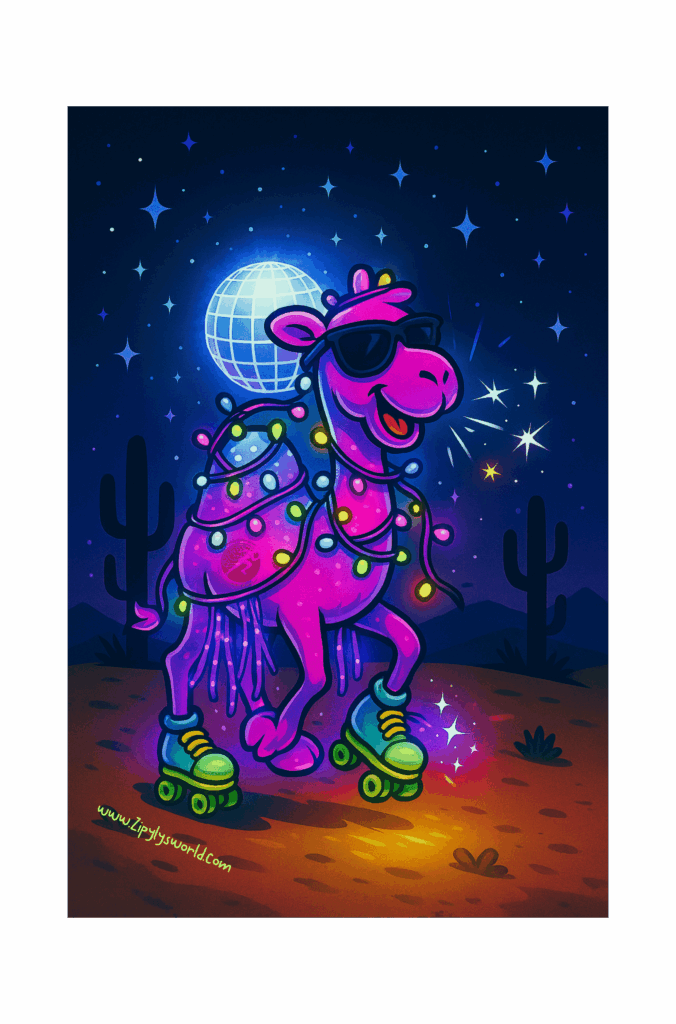
🐫 Desert wisdom: “You don’t need a magic pill – just the right plan. Everything else is bonus glitter.” – Zipyly
🪲 Bonus scene with Zamyly: While Zipyly talks seriously about “Energy vs Placebo”, Zamyly suddenly scurries into the picture – this time not on rollerblades, but as a glowing firefly camel. His hump flashes like a disco ball, tinsel strings hang from his legs and every time he sneezes, little fountains of glitter spray out into the desert. He proudly shouts: “I AM THE MERMAID SHAKE ON LEGS!” ✨🐪💥 Then he topples over because he’s tangled up in his own fairy lights and mumbles half aloud: “Maybe water with a pinch of salt instead…” Zipylyna laughs tears, Zipyly holds his forehead and comments dryly: “THAT, my dear, is the placebo effect in its purest form.”
💊 Desert Station 9 – Supplements: Useful or just expensive unicorn powder?
When marketing and reality don’t drink from the same oasis.
Zipylyna prepared for her next desert run. So… she thought. Her rucksack rattles and rustles like a minibar:
- 3 gels with the imprint “Rocket Fuel”
- 2 “Watermelon Storm” electrolyte powder
- 1 bottle of liquid magnesium (“just in case”)
- 1 recovery drink “Strawberry Vanilla Chai” with 32 ingredients – three of which she can pronounce
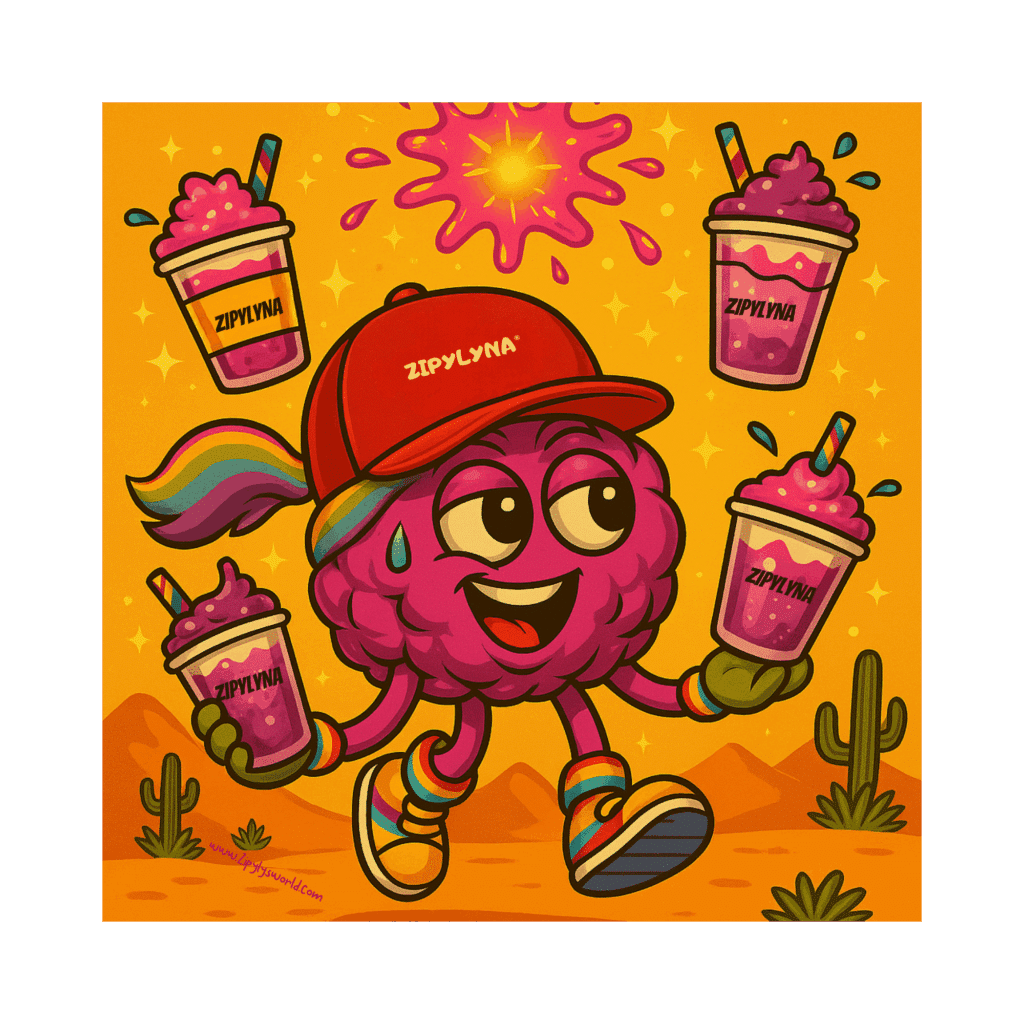
Zipylyna dances down the dune slope, juggling what feels like a dozen smoothies and singing in disco mode. “Do I want to run or open a desert pharmacy? – Yeah, yeah, yeah…”
🎯 What are supplements anyway?
Supplements = nutritional supplements ➡️ are not a must, but perhaps a useful extra. They are intended to help close nutrient or electrolyte gaps, support regeneration or improve performance. But: “Just because it’s brightly colored and expensive doesn’t mean your body needs it.”
🧂 1. electrolyte tablets & powder
- Contains: Sodium, potassium, magnesium, calcium
- Useful if:
- High welding rate
- long & intensive units
- Heat or multi-day events
- But:
- Check the composition – some have too little sodium or too much sugar
- Taste ≠ Effect
📚 ACSM recommendation: 300-600 mg sodium per hour during prolonged exercise to compensate for losses and prevent hyponatremia.
🍬 2. sports drinks with carbohydrates & proteins
- Combinations from:
- Carbohydrates (glucose, maltodextrin, fructose)
- Amino acids or protein isolates
- sometimes electrolytes + vitamins
- Useful if:
- no solid food is tolerated
- Ultra endurance range
- 2 hours load
- But:
- Protein during the run can cause stomach problems
- Often enough: water + carbohydrate snack (banana, bar)
🌿 3. natural alternatives
Zipyly pushes a bottle and a plate over to Zipylyna:
- 🥒 Cucumber water – sodium + minerals, good for cramps
- 🥥 Coconut water – high in potassium but low in sodium
- 🍋 Salt and lemon water – cheap, works, a matter of taste
“Sometimes it’s enough to drink wisely – not expensively.”
📊 Quick check: self-mixing vs. finished product
| Criterion | Finished product | Self-mix |
|---|---|---|
| Control over content | ❌ difficult to check | ✅ Completely customizable |
| Price | 💸 Often expensive | 💰 favorable |
| Flavor | 😋 mostly delicious | 🥴 Takes some getting used to |
| Customizable | ❌ limited | ✅ Freely selectable |
| Transportation | ✅ Practically packaged | ❌ Preparation required |
📦 4. marketing magic or real benefit?
Zipyly points to a can with the slogan: “Neuronal hyperhydration – now with rainbow sugar!” – “Sounds fancy. Is often just marketing gibberish with colored sugar.” Tip: Check the ingredients – not the advertising text.
Zipylys Tip:
You don’t need a pharmacy in your hydration pack. You need knowledge, strategy – and sometimes just a banana. Zipylyna shakes the glitter lid of her Mermaid Shake: “So… this was expensive, but it glitters. Does that also count as a placebo?” Zipyly grins: “If your stomach goes along with it and you believe in fairies – go for it.”

🐪 Zamyly’s end gag
There’s a rumble behind the dune. Zamyly rolls up – on a skateboard, overloaded with 20 colorful cans and bags that jingle wildly. He stumbles, a fountain of glitter powder explodes and he gasps dramatically: “I took EVERYTHING at once – now I’m a unicorn!” 🦄✨ Then he falls into the sand, sneezes out a cloud of magnesium dust and shouts: “Still tastes like banana!” 🍌 Zipyly and Zipylyna just roll their eyes and agree: “Supplements are like shooting stars: beautiful to look at, but not your lifeline. Your base is always training, nutrition & hydration – the rest is glitter. ” ✨🐪
Desert station 10 – Drinking systems in training & competition – 💦 Quench your thirst like a pro (…or a desert fox 🦊)
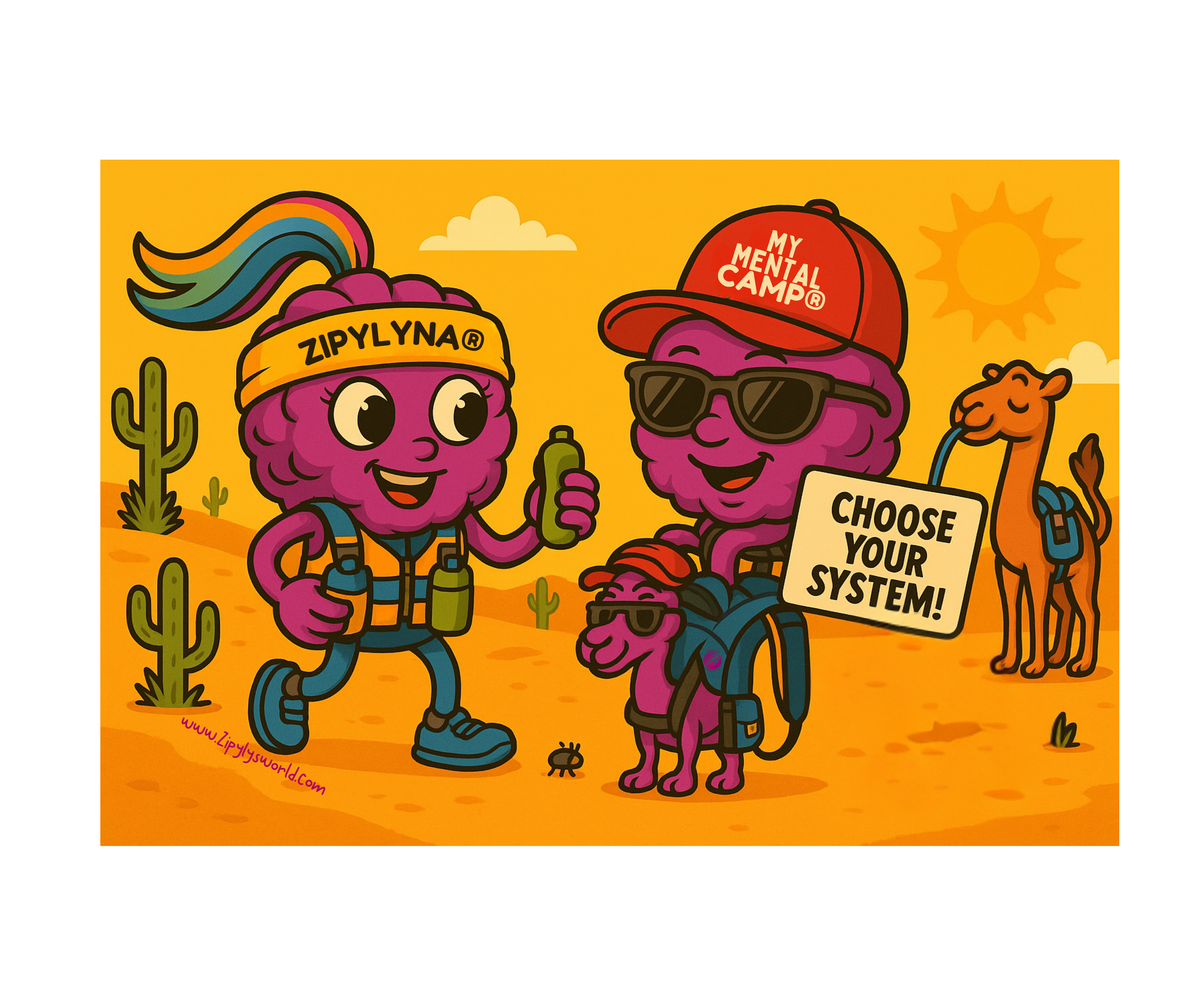
The sun is burning 🔥, the sand crunches 🏜️, and Zipyly trudges ahead – his red hat glowing like an oven on convection. Next to him, Zipylyna drags a hydration pack that looks like it has more compartments than a Swiss army knife 🗡️. The drinking tube curls around her neck like a particularly thirsty python 🐍. Zipyly : “Are you sure you can still run with this thing?” Zipylyna: “Of course 😎! It barely weighs more than my last shopping bag… full of melons 🍉.” Zipyly: “Ah. So five kilos of extra training. 💪”
🥤 The three major drinking system categories:
| System | Description | Advantages 😍 | Disadvantages 😬 |
|---|---|---|---|
| Handheld bottles | Small bottles with handle loop, carried directly in the hand. | Quickly accessible, easy to clean, perfect for short runs. | Annoying over long distances, one hand constantly occupied. |
| Softflasks | Soft bottles, often in vests or belts. | Space-saving, lightweight, no gurgling, fits snugly when empty. | Needs to be refilled more often, drink gets warm more quickly. |
| Drinking belt | Belts with small bottles or holders. | Even weight distribution, quick removal. | Can slip, presses on hips. |
| Hydration backpack/vest | 1-3 liters, tube for drinking while running. | Ideal for long runs/ultras without food, hands free. | More weight, hose annoying to clean, can chafe. |
🤓 Practical tips from Zipyly & Zipylyna:
- 🧼 Cleaning is not a hobby – but mandatory drinking systems are like cacti: hard on the outside, alive on the inside 🌵. At the latest after an isotonic drink in the tube, you have a small biotope 🦠. 👉 Rinse after every run, blow out the tube and leave it open to dry.
- 🌞 Heat vs. ❄️ Cold
- Heat: Insulated tubes or bottles prevent your drink from turning into soup 🍵.
- Cold: In the desert it can get freezing cold at night 🥶 – and in winter your inner tube will freeze faster than a camel can say “Pfffrrt” 🐫💨. Put the hose under your jacket or blow it out after drinking.
- 🏋️ Train like you fight Use the same system in training as you do in competition. 👉 Otherwise you’ll end up like Zipylyna, who suddenly starts the race with a hydration pack and realizes after 5 km that the tube is in the wrong direction… and she has baptized half her face with iso. 😂
📍 When which system?
| Distance / Situation | Recommendation |
|---|---|
| < 10 km | Handheld bottle or soft flask |
| 10-25 km | Soft flask, drinking belt |
| > 25 km or Trail/Ultra | Hydration backpack/vest with 1-2 liters |
| Extreme heat/seclusion | Backpack + additional bottles |
| Winter/high mountains (> 2000 m) | Insulated bottle or tube under clothing |
💡 Hack: Don’t wait until the race to test your hydration system. Do at least a few training runs with it, find out how easily you can drink while running and whether the taste of the water is still pleasant after an hour.
Zipyly’s opinion on drinking systems:
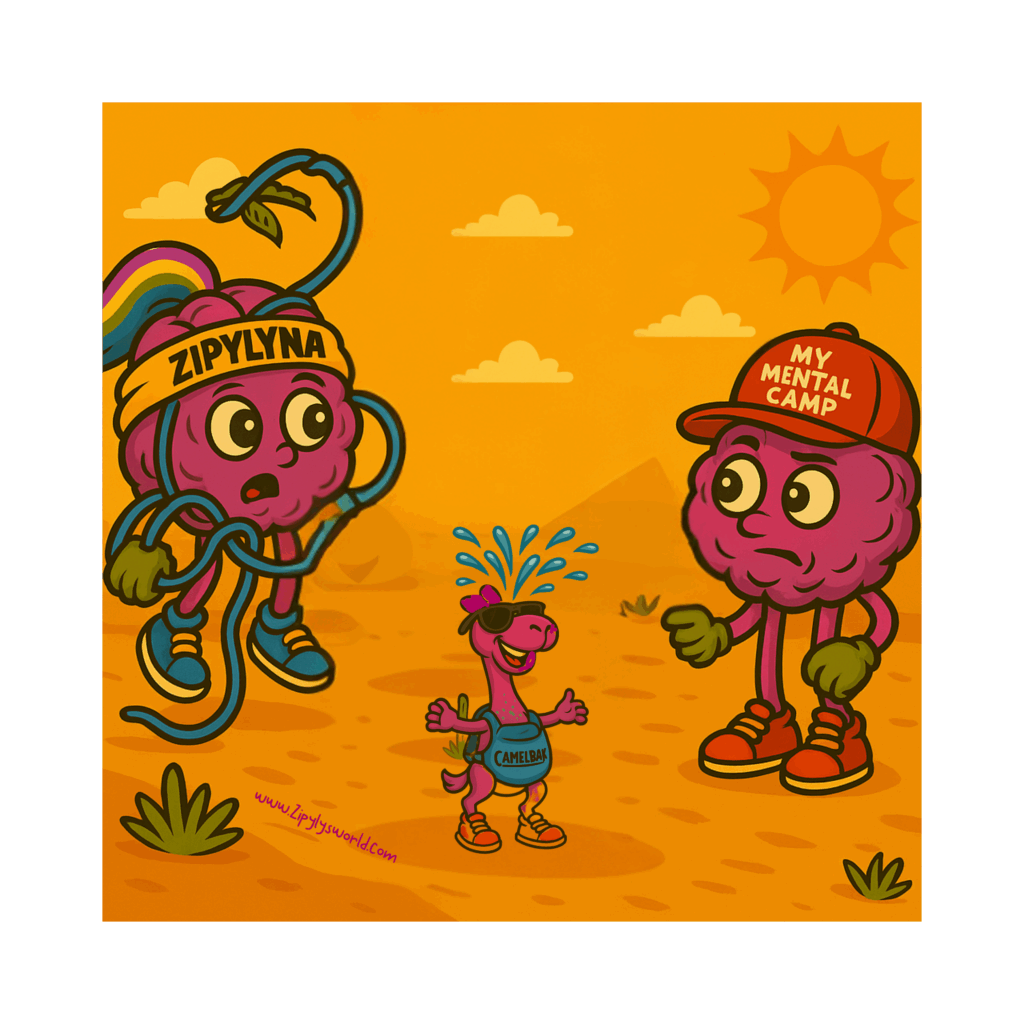
Whether it’s a water bottle, soft flask or hydration bladder – the best system is the one that suits you, provides you with fluids in good time and doesn’t surprise you during the race. Test it out beforehand, play through scenarios and treat it like your running shoes: a tool that will get you to the finish line – not a “tummy ache during the race” adventure. Zipyly leans back as Zipylyna tries to untangle the tangled hose. “You know,” he says, “whatever system you choose – the most important thing is that it works before you’re thirsty 😏.” Zipylyna nods… and gets even more tangled up. The knot now looks like a modern work of art 🖼️.
💡 Now that we know how to carry water 💧, we’ll clear up the last nasty questions in the FAQs and glossary: from “Can you drink too much?” 🤯 to “How do I clean a soft flask without it smelling like an old sports drink?” 🤢 You’ll get the answers here – compact, clear and with an extra dose of desert humor.
🐪 Wisdom of the desert
“A camel never walks without a memory – you shouldn’t take a step without a plan.” – Zipyly
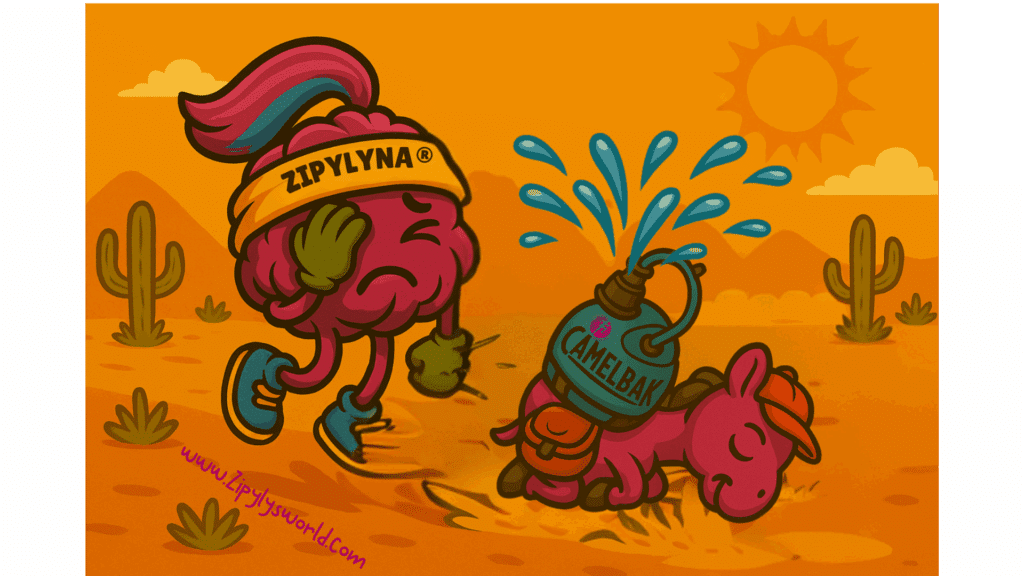
…and Zamyly 🤪 – It rattles behind them. Zamyly has strapped a complete Camelbak onto his stomach the wrong way round. It gushes out of the drinking tube like a fountain. He is beaming from ear to ear: “Look at me! I’m a mobile oasis!” 🌴💦 Then he stumbles, lands upside down in the sand and one last drop hisses out of the hose – directly into his own bump. Zipyly sighs: “He’s almost got the principle…”
FAQs – questions that can save your head in the desert (or in a marathon) 🏜️🏃♀️💦
1️⃣ “Can’t I just drink when I’m thirsty?”
Yes and no. Your feeling of thirst is a pretty good mechanism – but unfortunately a late detector. By the time Zipyly gets thirsty, he’s usually already in “I’ll suck the cactus” mode in the desert 🌵🤦♂️. Your body reacts more slowly to heat, cold or altitude. So it’s better to drink preventively so that you don’t go into “Water? Yes please!” emergency mode.
2️⃣ “Can you drink too much?“
Oh yes – it’s called hyponatremia. Zipylyna once emptied her Camelbak before the start arch for fear of dying of thirst 😆💦. Problem: Too much water without electrolytes dilutes your blood → salt content drops → cells swell → life-threatening in the worst case. Remember: drink yes – but with brains (and salt). 🧂
3️⃣ “How much can my body actually absorb?”
The body is not a bucket – more like a high-tech cactus 🌵🤓. It usually manages 0.8-1.0 liters per hour. More ends up in the stomach and causes the infamous “floppy water dance”. With heat + high intensity you can do a little more, but your digestive system still sets a limit.
4️⃣ “Cold? I’m not sweating, am I?”
Wrong idea, frostbite! 🥶 In the cold, you breathe in dry air that needs to be humidified → water loss through breathing. Plus: more layers, more movement, more metabolic heat. Zipyly once thought “No problem” in a snowy desert – two hours later he was as dehydrated as after a Sahara stage 🏂.
5️⃣ “And at altitude?”
From 3,000 m you breathe faster → more fluid is lost through the lungs. Your body also draws water into the blood to compensate for the lower oxygen content. Result: thirst + urge to urinate + weak circulation. Zipylyna says: “Take a selfie 📸 – and then drink IMMEDIATELY.”
6️⃣ “Do I also need electrolytes in winter?”
Yes, whether summer or winter – you always lose sodium, potassium & co. In winter, you often sweat unnoticed under your layers. A warm isotonic drink can be just as sexy in a snowstorm as it is in a desert storm ❄️🔥.
7️⃣ “Which is better: small sips or large quantities?”
Zipylyna test:
- Camel style 🐫 – all at once → Tummy says: “Uh, no!” 🤢
- Butterfly style 🦋 – sip every now and then → stomach happy, liquid arriving evenly. Result: gain small, regular sips.
8️⃣ “How do I recognize that I am dehydrated?”
Checklist:
Thirst (later indicator)
✅ Dark urine (tea color = alarm!)
Headache
✅ Sudden tiredness/concentration hole
✅ Zipyly is suddenly thinking more about chocolate 🍫 than about the finish line → time to drink.
9️⃣ “Do I have to drink during every training session?”
It depends:
- Up to 60 min easy often not necessary – unless hot/cold or preloaded.
- From 90 min or high intensity: Yes. Marathon preparation? Test your race drink during training – not just on race day.
🔟 “What is the perfect drinking temperature?”
Lukewarm is top. Cold = stomach stress 🥶, hot = tea party instead of hydration 🍵. Zipyly once tipped ice water at 35 °C → spontaneous belly dance interlude (unplanned). 💡 Zipyly’s mnemonic: “Drink so that you never get thirsty – and so that your stomach doesn’t protest. Because neither the oasis nor the porta-potty are always there when you need them.” 🚽🌴
Glossary – or: The TLS monastery where no one has to pray 🙏💧
Welcome to the legendary TLS monastery. Don’t worry – there are no vows of silence or gray robes here. TLS does not stand for tea, latte, smoothie, but for: Tables, Lists & Synapse Rescue. Because after all those desert marches, camel saddles and drinking system debates, your brain needs a safe place where it can take a breather. A mental safe space where complicated words and technical terms are tamed like little wild desert foxes. 🦊 Zipyly and Zipylyna sit here on cozy cushions, Zipyly with a pot of peppermint tea (because he thinks it cools the synapses), Zipylyna with a coconut in his hand – and they calmly explain to you what’s behind all these terms without you disappearing in a Google sandstorm.
A
Adaptation
The body’s ability to adapt to external conditions such as heat, cold or altitude. Or, as Zipyly says: “It’s like yoga – only here it’s not you that bends, but your circulation.” 🧘♂️
Aerobic capacity
Your body’s ability to absorb oxygen and use it to generate energy. Your internal solar power plant, so to speak – works best when the tank (aka water balance) is full.
Aldosterone
A hormone that regulates the salt and water balance. Zipyly compares it to a strict bouncer that decides exactly how much sodium and water is allowed in or out.
B
Basal rate
The basic amount of energy that your body burns in absolute chill mode. Even if you’re just lying around counting desert bugs, the basal rate continues. 🪳
Blood plasma volume
The liquid part of your blood in which cells and nutrients float. If there is too little fluid in it, it becomes viscous like old syrup – and your circulation doesn’t like that at all.
C
Camelbak effect
The unconscious continuous sucking from a drinking bladder without realizing how much you have actually drunk. Zipyly warns: “This can be good or bad – depending on the contents.” 🐪
Cortisol
Stress hormone that influences your fluid balance, among other things. Too much cortisol can dehydrate you – almost like the sun at 12 noon in the Sahara.
D
Dehydration
A condition in which the body loses more water than it absorbs. Symptoms: dry mouth, dizziness, bad mood – and, according to Zipylyna, “the feeling as if someone is blow-drying your brain with a hairdryer”.
Thirst mechanism
Your body’s built-in alarm system that encourages you to drink. Unfortunately, it often sounds too late – especially in the cold or at high altitudes.
E
Electrolytes
Minerals such as sodium, potassium and magnesium, which are important for nerves, muscles and water balance. Zipyly explains: “It’s like the fine sand in the desert – without it, the whole transmission slips.”
Euhydration
The perfect fluid balance – not too little, not too much. Zipyly calls it “the Zen zone of water balance”.
G
Glycogen
A storage form of carbohydrates in muscles and liver, binds water like a sponge. That’s why you often weigh more after a pasta party – it’s not fat, it’s water, baby! 🍝💧
H
Hyponatremia
Too little sodium in the blood – often due to overhydration. Can be dangerous because your cells start to “swim”.
Hypohydration
Slight water shortage – not yet a catastrophe, but your body is no longer running at 100%.
O
Osmosis
The physical process by which water flows through a membrane. Zipyly calls it “the fart effect for cells” – everything wants to go where it is in balance.
P
Plasma osmolality
A measure of how concentrated the particles in your blood plasma are. Zipylyna says: “The higher, the more your body is crying out for water – or for a very salty snack.” 🥨
R
Rehydration
The process of replenishing fluid after losses. Faster with electrolytes than with water alone.
T
Thermoregulation
The process by which your body maintains a constant temperature – whether you are in the ice or in the desert.
V
Volume status
Total amount of fluid in the body at a given time. If it is too low, even the smallest hill will feel like Mount Everest.
💡 Note: The glossary is based on the most important technical terms from the book chapter and combines scientific precision with the slightly slanted glasses of Zipyly & Zipylyna.
📚 Source & study references:
(Or: Why Zipyly and Zipylyna don’t just talk “from the gut”)
Lest you think we made it all up over a coconut at lunch 🥥 – here are the most important scientific sources that support our statements. Here are a few reading tips if you want to delve deeper.
💦 Hydration & fluid balance
- Sawka, M.N. et al. (2007): American College of Sports Medicine position stand. Exercise and fluid replacement. Medicine & Science in Sports & Exercise, 39(2), 377-390.
- Cheuvront, S.N. & Kenefick, R.W. (2014): Dehydration: physiology, assessment, and performance effects. Comprehensive Physiology, 4(1), 257-285.
- Maughan, R.J. & Shirreffs, S.M. (2010): Dehydration and rehydration in competitive sport. Scandinavian Journal of Medicine & Science in Sports, 20, 40-47.
🧂 Electrolytes & hyponatremia
- Hew-Butler, T. et al. (2015): Statement of the 3rd International Exercise-Associated Hyponatremia Consensus Development Conference. Clinical Journal of Sport Medicine, 25(4), 303-320.
- Rosner, M.H. (2009): Exercise-associated hyponatremia. New England Journal of Medicine, 360, 154-161.
🌡 Temperature, altitude & environmental factors
- Chapman, R.F. et al. (2013): Altitude training considerations for the winter sport athlete. Scandinavian Journal of Medicine & Science in Sports, 23(3), 88-96.
- Castellani, J.W. & Young, A.J. (2016): Human physiological responses to cold exposure. Comprehensive Physiology, 6(1), 443-469.
🚰 Drinking strategies in sport
- Goulet, E.D.B. (2012): Effect of exercise-induced dehydration on endurance performance: evaluating the impact of exercise protocols on outcomes using a meta-analytic approach. British Journal of Sports Medicine, 47, 679-686.
- Kenefick, R.W. (2018): Drinking strategies: planned drinking versus drinking to thirst. Sports Science Exchange, 29(196), 1-6.
💡 Note:
Some of the cited studies are freely available online in full text, others only via scientific databases. Zipyly recommends: “Don’t be put off by paywalls – often the abstract is enough to understand the key messages.” And Zipylyna says: “Or just ask us – we’ll translate the scientific gobbledygook into normal human language.” 😄
On a personal note:
“And if you want to have your oasis with you in everyday life too
🌴🐪💧- take a look at Zipyly’s World on Etsy https://www.etsy.com/shop/ZipylysWorld
🛒✨. Our latest hydration merch pieces are waiting for you there 🎒🧢🚰.”
For more Chaos sign up here:
[mailerlite_form form_id=1]